

Orthopedics
Joint replacement: considered when function, not just imaging, justifies it.
Replacing a hip or knee joint is considered when pain and loss of function persist despite appropriate non-surgical treatment. The decision rests on how the joint affects your life, not on the appearance of a radiograph alone.
Receive information about the coordination process and the healthcare partners available for your request.
 Orthopedics
At a glance
Quick facts
- Treatment type
- Orthopedic; surgical or non-surgical depending on diagnosis
- Typical care setting
- Licensed hospital with orthopedic and rehabilitation services
- Anaesthesia
- If applicable, determined by the surgical and anaesthesia team
- Hospital stay
- Varies by procedure and case
- Rehabilitation
- Individualized; a substantial part of the outcome
- Follow-up
- Required as advised by the treating physician
What is this treatment?
The damaged joint surfaces are replaced with prosthetic components. Hip and knee replacement are the most commonly discussed; shoulder and other joints are performed in appropriate cases.
Why might it be considered?
Typically advanced arthritis with persistent pain, night pain, loss of walking distance and reduced independence, where non-surgical management has been tried and is no longer sufficient.
Who may or may not be a suitable candidate?
Assessment considers:
- the severity of symptoms and their effect on daily function
- what non-surgical treatment has already been tried
- general health, anaesthetic fitness and cardiovascular risk
- weight, muscle condition and the capacity to complete rehabilitation
- infection risk, dental and skin health
- expectations about activity after surgery
Medical assessment and planning
Examination, imaging and a discussion of what a replacement can and cannot restore. A prosthetic joint relieves pain and improves function for many people, but it does not make a joint equivalent to an undamaged natural one.
How the treatment generally works
In broad terms: anaesthesia, removal of damaged joint surfaces, implantation of prosthetic components, closure, and early mobilisation supported by physiotherapy, often on the same or the following day.
Preparation
Pre-operative assessment and optimisation, dental review where advised, prehabilitation exercises, home preparation for reduced mobility, and planning for the rehabilitation period.
Recovery and what to expect
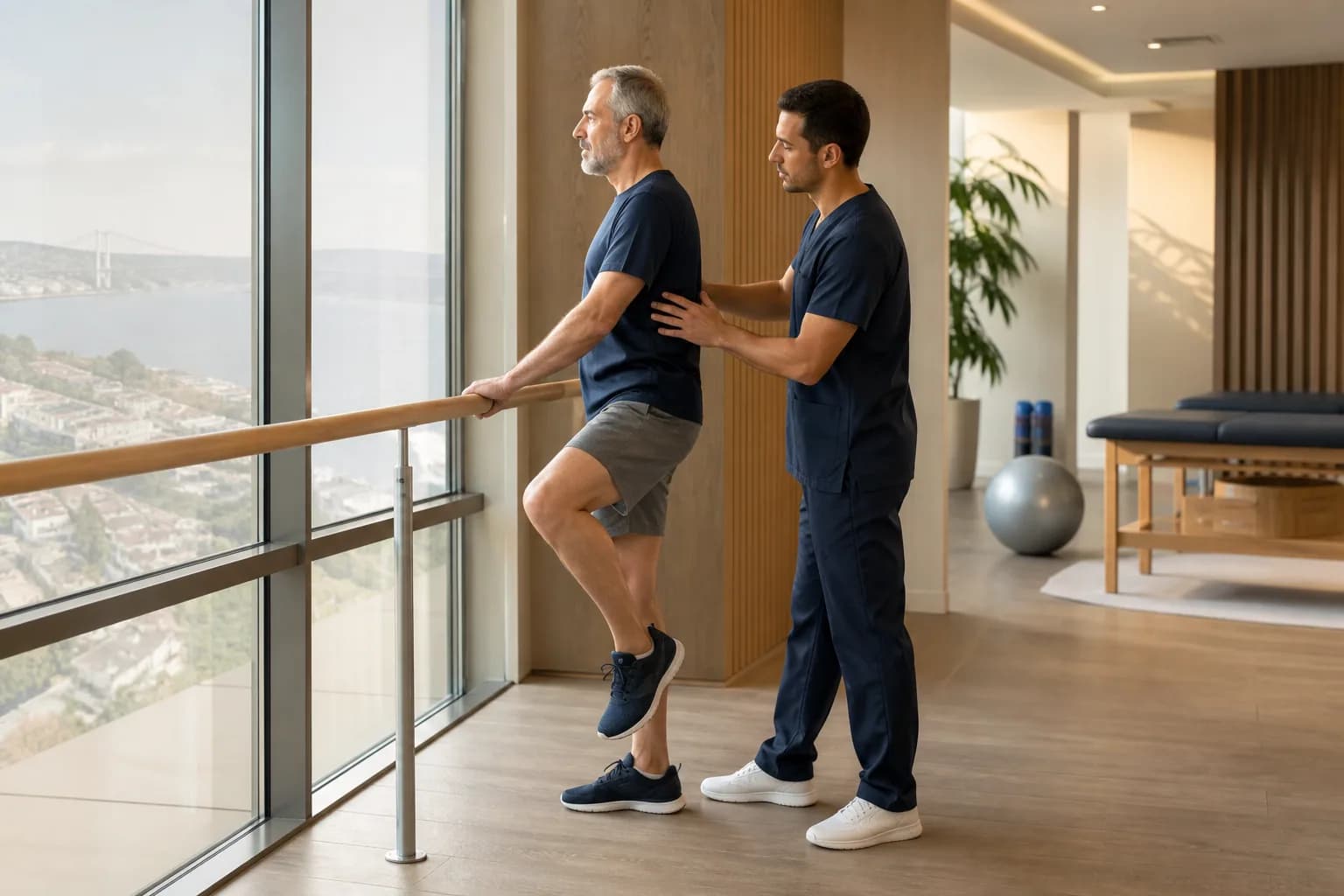
Rehabilitation begins early and continues for an extended period, most of it after you return home. Mobility aids are used initially, and progress is measured over months rather than days.
Risks and important considerations
Risks include infection — including deep infection around the implant — blood clots and pulmonary embolism, dislocation, fracture, nerve or vessel injury, leg-length difference, stiffness, persistent pain, implant loosening or wear over time, and the possibility of revision surgery. Anaesthetic and medical risks apply.
Implant longevity varies with the individual, the joint, activity level and other factors, and no specific lifespan can be promised.
Alternatives and related options
Physiotherapy, weight management, walking aids, pain management, activity modification and, in selected cases, injections or joint-preserving surgery.
International travel considerations
This is a major operation with a long rehabilitation and specific clot risk around air travel. Flight timing is a clinical decision, transfers and accommodation must accommodate reduced mobility, and continuity of physiotherapy at home should be arranged in advance.
How Wadi coordinates the journey
Medical assessment, diagnosis and treatment are provided by the relevant licensed healthcare institution and physician. Wadi Health Tourism coordinates the international patient journey and related intermediary services.
Common questions
It varies with the individual, the implant, activity and other factors. No specific number of years can be promised, and revision surgery is possible at some point.
Your surgical team decides, taking clot risk and your mobility into account. Do not book a fixed return date before that conversation.
High-impact activity is often discouraged after joint replacement. Discuss your specific activity goals before surgery, because they may influence the recommendation.
Related treatments
Arthroscopic surgery
Arthroscopy lets a surgeon look inside a joint through small incisions and treat certain problems found there. Whether it helps depends entirely on what is wrong — for some conditions it is effective, for others it is not.
Arthroscopic surgeryOrthopedicsRegenerative medicine
This area contains a small number of applications with reasonable supporting evidence and a large number promoted well beyond it. We describe only what is legally permitted and clinically supported, and we say clearly where evidence is limited.
Regenerative medicineOrthopedicsSports medicine
Sports medicine treats injuries to muscles, tendons, ligaments and joints, and most of that treatment is not surgical. The goal is a return to activity at a level and timescale the tissue can support.
Sports medicineAwaiting medical review
This page has been prepared by the editorial team and is queued for review by a qualified physician. It is published for information and is not indexed until that review is complete.
Last updated September 1, 2026
This content is for general information and does not replace an individual medical assessment. Treatment suitability, technique, expected recovery and possible risks vary by patient and must be evaluated by a qualified physician.
Start with a simple conversation.
Receive information about the coordination process and the healthcare partners available for your request.
We do not publish treatment prices. Any estimate depends on an individual clinical assessment and is provided by the treating healthcare institution.